Unlocking Excellence
SEO vs GEO in 2025 — Why Visibility Now Means Being Cited, Not Just Ranked
If you’ve felt your organic traffic wobble lately—even with solid rankings—you’re not alone. Search is quietly shifting from lists of links to direct, AI generated answers. Traditional SEO still matters, but a new discipline—GEO (Generative Engine Optimization)—is rising fast. The goal is no longer just to rank; it’s to be referenced and cited inside AI results from tools like Google AI Overviews, Microsoft Copilot, ChatGPT, and Perplexity.
The Market Reality (2025)
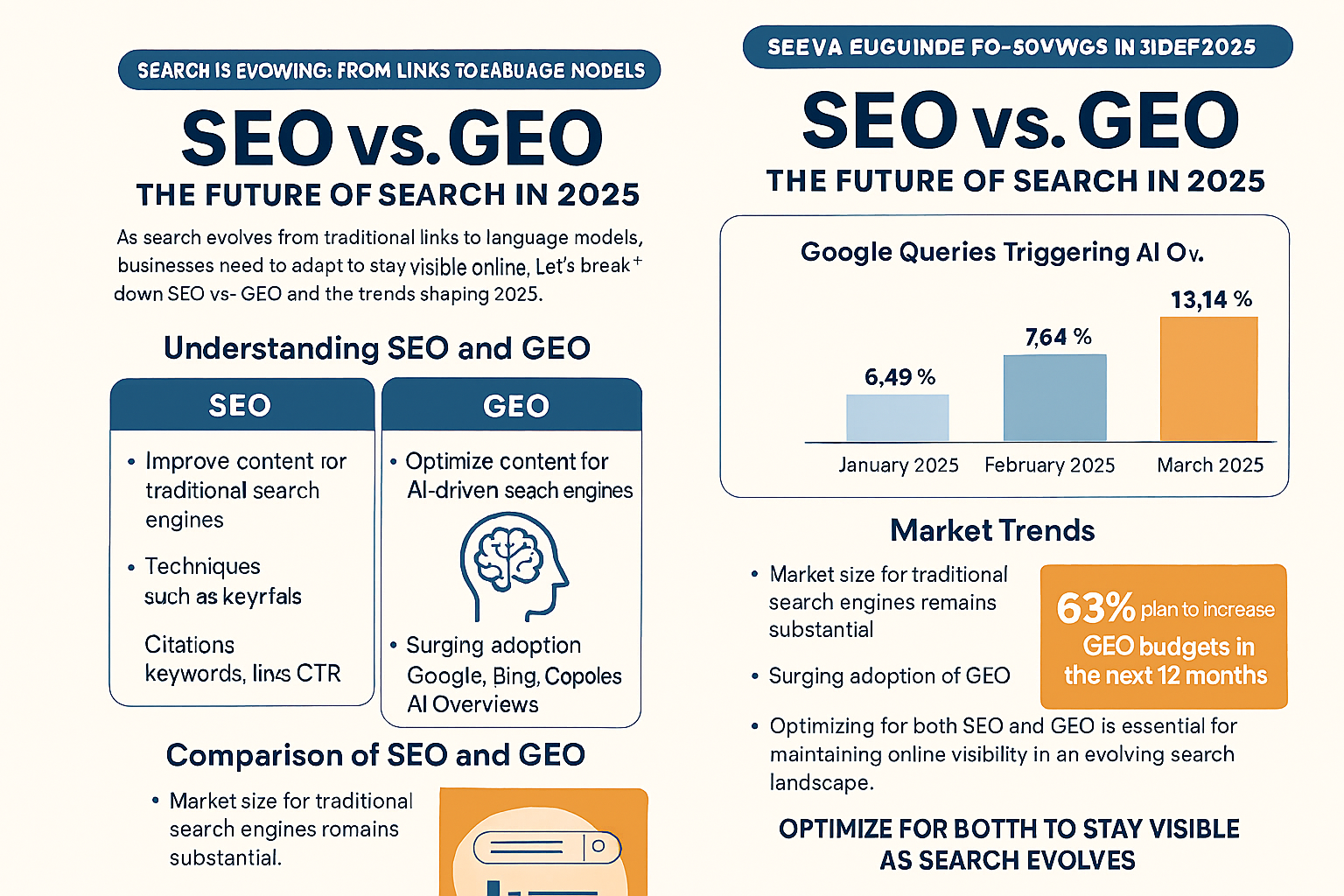
Evidence of the shift is everywhere. A large Semrush analysis reports that AI Overviews appeared in 13.14% of Google desktop queries in March 2025, up from 6.49% in January—a rapid expansion into mainstream search behavior.
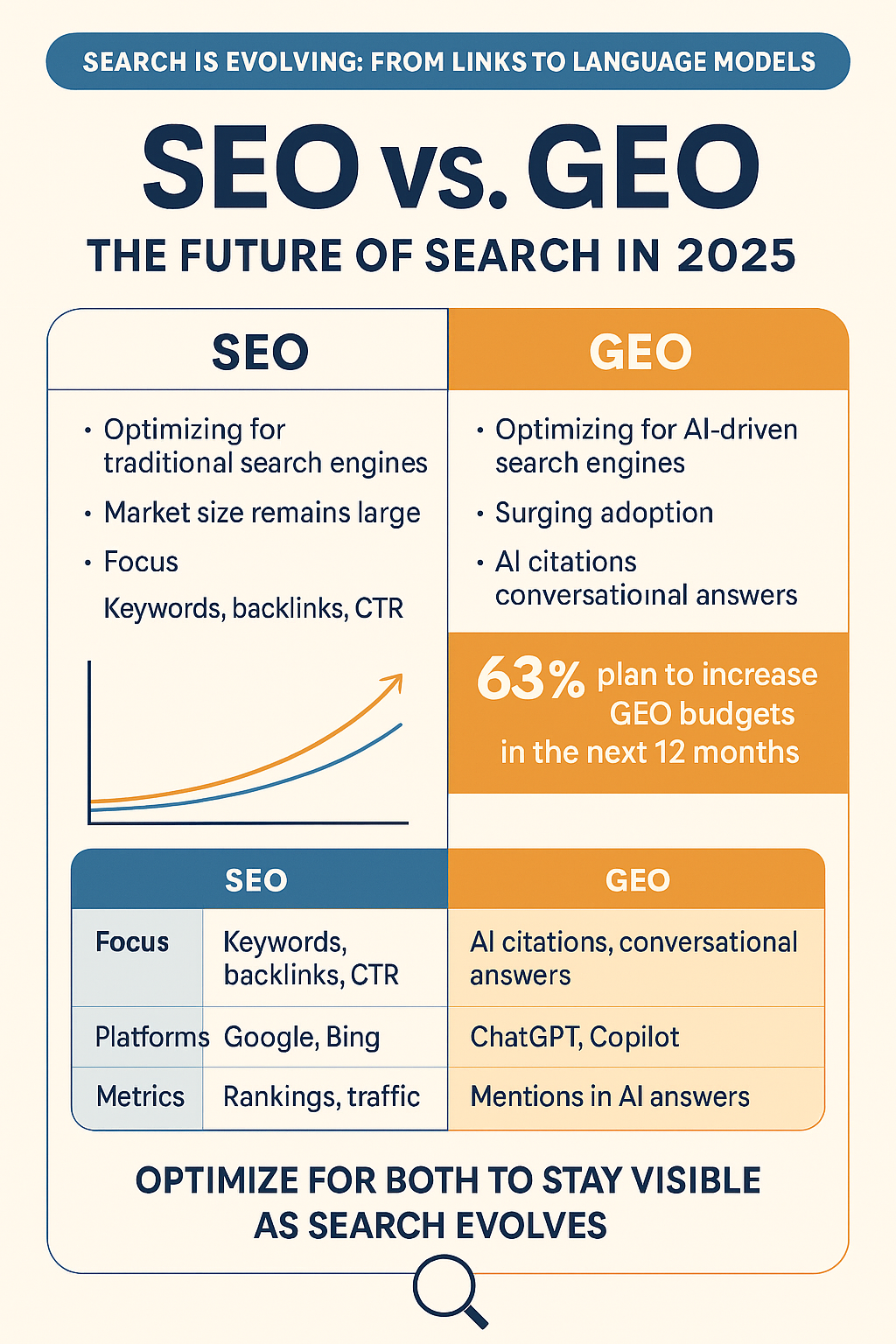
At the budget level, GEO has reached parity with traditional search investment: 78% of companies fund GEO and 63% plan to increase GEO spend over the next year—despite flat overall marketing budgets. That’s a turning point: GEO isn’t a side project anymore; it’s becoming a core pillar.
SEO vs GEO—In Plain English
• SEO helps your pages rank in classic search results using keywords, backlinks, technical health, and strong UX. It’s still the bedrock of discoverability on Google and Bing. [blog.oxfor...keting.com]
• GEO helps your content get cited inside AI answers. That requires factual density, clear structure (Q&A blocks, lists, tables), schema, consistent authorship signals, and freshness so LLMs can parse, summarize, and trust your pages.
Think of SEO as putting up the best signboard on a busy street. GEO is writing the script that the concierge delivers when someone asks for recommendations. If you’re not in that script, you might not get mentioned—even if you rank well.
Why GEO Matters Right Now?
AI answers reduce the need to click, especially for informational queries. Semrush’s dataset shows informational queries comprise ~88% of AI Overviews, and the share is expanding across science, health, people & society, and law/government—domains where users expect quick, trustworthy answers.
For marketers, that means the top of the funnel is narrowing. Instead of ten blue links, users often see a compact summary citing only a handful of sources. Getting included becomes the battleground. That’s GEO.
A Unified Strategy: Win Rankings and Citations
Rather than choosing SEO or GEO, modern teams integrate both. Here’s a practical, human friendly framework you can start this quarter.
1) Ground Everything in People First Content (Still the #1 Driver)
Create content that answers specific, real questions your audience asks. Use conversational headings, direct answers near the top, and supporting detail below. This format helps both users and LLMs.
Checklist (GEO + SEO):
• A clear TL;DR or Key Takeaways block at the top
• Q&A sections for common prompts (“Is…?”, “How…?”, “What’s the difference…?”)
• Cited facts with dates and sources in-line
• Tables/lists for scannable comparisons (LLMs love precise structures)
2) Strengthen Entity & Trust Signals
LLMs and Google’s systems value E E A T (experience, expertise, authoritativeness, trust). Add author bios, organization schema, FAQPage/HowTo/Article JSON LD, and verifiable references. Refresh critical pages at least quarterly.
3) Engineer for Machine Readability
Make it easy for AI systems to parse your pages:
• Use structured data (JSON LD) for products, reviews, org, FAQs.
• Keep key facts out of heavy JS; render plain HTML for crawlable details.
• Maintain clean internal linking; cluster related topics to establish topical authority.
4) Track the Right Metrics (Beyond Rank)
• SEO KPIs: rankings, impressions, CTR, organic clicks, conversions.
• GEO KPIs: citation frequency, share of citations vs competitors, AI Overview presence for target queries, and brand mentions in answer engines. (Many teams instrument this with manual spot checks and third party trackers.)
5) Budget Realistically
Recent survey data shows organizations are testing GEO cautiously while keeping core SEO spend intact. A pragmatic split: anchor budgets in SEO, carve out incremental GEO for high impact topics (where AI Overviews appear). Iterate monthly.
SEO vs GEO: Quick Comparison Table
| Dimension |
SEO (Search Results) |
GEO (AI Answers) |
| Primary Goal |
Rank & earn clicks |
Be cited & summarized |
| Best Query Types |
Clear intent, commercial, navigational |
Conversational, multi intent, informational |
| Content Patterns |
Comprehensive pages mapped to intent |
Q&A blocks, TL;DRs, lists, tables, explicit facts |
| Tech Signals |
Crawlability, CWV, internal links |
JSON LD schema, entity clarity, provenance |
| Core Metrics |
Rankings, CTR, clicks |
Citation frequency, share of voice |
90 Day Action Plan (Humanized & Doable)
Weeks 1–2: Discovery & Baseline
• Identify 20–30 priority queries where AI Overviews appear (or likely to soon).
• Audit your top pages: add TL;DR, Q&A, schema, fresh sources, and explicit dates.
Weeks 3–6: Content Upgrades
• Publish 3 cornerstone guides with answer ready sections, rich citations, and updated data.
• Convert existing posts into scannable structures (tables/lists).
Weeks 7–10: Authority & Signals
• Add author bios + About/Editorial policy pages; standardize citation style.
• Implement FAQPage, Article, and Organization schema across upgraded content.
Weeks 11–12: Measurement & Iterate
• Track AI Overview presence and brand citations for target prompts; compare vs SERP rank and CTR.
• Double down on pages that earn mentions; refine those that don’t.
FAQ (Answer Ready for GEO)
IS GEO replacing SEO ?
No—GEO complements SEO. You still need technical health, topical authority, and links. GEO adds answer engine visibility so you’re included when AI summarizes.
Which industries are most affected by AI Overviews?
According to a Semrush’s study: Science, Health, People & Society, and Law & Government show the largest AI Overview growth shares so far.
How much should we invest in GEO right now?
Clutch’s 2025 survey shows 78% of companies fund GEO; 63% plan to increase budgets. Start with incremental GEO on high impact topics while maintaining your SEO foundation.
Navigating the evolving search landscape requires more than just keywords and backlinks—it demands a dual approach that combines traditional SEO excellence with next-generation GEO strategies. This is where Hakua Works Technologies steps in.
Hakua Works specializes in:
• Comprehensive SEO Audits & Optimization: From technical health checks to content strategy, ensuring your site ranks high on traditional search engines.
• GEO-Ready Content Frameworks: Crafting answer-friendly content structures—Q&A blocks, TL;DR summaries, schema markup—that make your pages easy for AI engines to cite.
• Entity & Trust Signal Enhancement: Implementing E-E-A-T best practices, structured data, and authoritative signals to boost both rankings and AI visibility.
• Performance Tracking Across Both Channels: Monitoring SERP positions and AI citation frequency so you know where you stand—and where to improve.
With Hakua Works, you don’t have to choose between SEO and GEO. You get a unified strategy that keeps your brand visible in search results and AI-generated answers, ensuring you stay ahead as search evolves.